
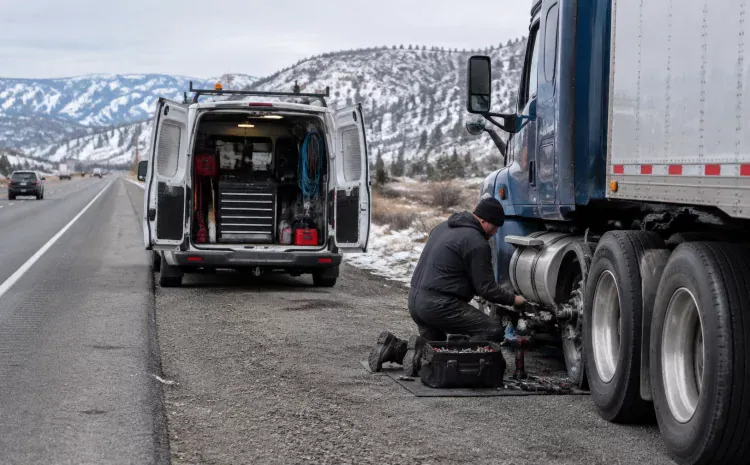
Do You Really Need a Mobile Truck Mechanic in Reno and Sparks? Here’s the Truth
If a truck goes down in Reno or Sparks, you have two options: call a tow and wait for a shop bay, or have a mechanic come to you. Most fleet managers have used both, and most have a story about the tow that cost more than the repair. This is the honest version of that comparison along the I-80 corridor between Northern California and the Reno-Sparks area, with no sales pitch. By the end, you will know when a mobile truck mechanic is the right call, and when it genuinely is not.
The real cost of a breakdown far from a shop
The sticker price of a repair is never the whole cost. When a truck breaks down somewhere between Sacramento and Reno, the expenses stack up in layers, and most of them start before a wrench is ever turned. We covered the geography of this in our guide to the Bay Area’s toughest routes, where steep grades and stop-and-go traffic already push cooling systems and brakes to their limits.
A heavy-duty tow is the first layer. For a loaded tractor-trailer, a long-distance tow along a Sierra corridor can easily run into four figures before anyone has even diagnosed the problem. If the breakdown happens near Donner Pass or on a stretch of I-80 where heavy towing is complicated by weather and traffic, that number climbs further.
The second layer is queue time. A truck that arrives at a busy shop on a Monday might not reach a bay until Wednesday. During that window you are paying for the truck without it earning anything, and you may be paying for a rental or a substitute driver too.
The third layer is the one that hurts most: missed commitments. A delivery window that slips by two days does not just cost money. It costs the trust of the customer waiting on the other end.
A mobile truck mechanic removes most of the first layer and much of the second. There is no tow, and diagnostics start the moment the technician arrives. For many common failures, the truck is back on the road the same day. Delta’s mobile fleet repair services cover exactly this range, from roadside failures to scheduled yard visits.
What a mobile truck mechanic can actually handle on-site
There is a persistent myth that mobile service is only good for jumpstarts and tire changes. Modern mobile units are workshops on wheels, and a well-equipped technician can handle far more at your yard or on the shoulder, from brake repairs to hydraulics and electrical faults:
- Computer diagnostics and fault-code troubleshooting
- Brake inspections, adjustments, and component replacement
- Electrical faults, alternators, starters, and battery replacement
- Cooling system repairs, hoses, belts, and water pumps
- Hydraulic repairs on liftgates, dump bodies, and refuse equipment
- Air system leaks, air dryers, and compressor issues
- Tire and wheel-end service
- Preventive maintenance visits at your yard during off-hours
For fleets running routes between Northern California and the Reno-Sparks area, that list covers the majority of roadside and yard failures. When a technician comes to you with the right equipment, a problem that would have consumed two days of towing and queue time can be a same-day fix.

Brakes deserve a special mention here. Brake failures are among the most common roadside stops, and they are also one of the easiest problems to catch early. Our guide to common mobile brake repair mistakes walks through how small brake issues become inspection failures, and why scheduling brake work before a route matters more than most fleets realize.
When mobile is not the right answer
An honest comparison has to include the other side. Mobile service is not a replacement for a full shop, and a good provider will tell you so.
Some jobs genuinely need shop infrastructure. Major engine overhauls, transmission removals, and work requiring a lift, a crane, or heavy welding belong in a facility built for them. Jobs that will keep a truck down for days regardless are usually better handled at a shop where the technician has full tooling and parts supply on hand.
There is also the diagnostic gray zone. If a fault cannot be identified in the first on-site visit, a shop visit with broader equipment may still follow. The difference is that the tow happens only after the mobile visit has already ruled out the quick fixes, which often narrows the problem and saves the shop time and you money.
Why this matters specifically in Reno and Sparks
Fleets based in or running through the Reno-Sparks area face a combination that makes on-site service especially valuable.
The region sits at the junction of major freight corridors, with I-80 running east to west and US-395 running north to south. A truck disabled here is often far from the nearest heavy-duty shop with an open bay.
Winter changes the math further. From late fall through early spring, chain controls on Donner Pass and other Sierra stretches slow traffic and extend response times. Every hour a disabled truck waits for a tow is an hour the weather can make worse. Getting a technician to the truck directly, rather than moving the truck to the technician, keeps the repair window as short as the conditions allow.
Weather also drives failure types. Cold mornings expose weak batteries, hard-starting engines, and moisture in air systems. A mobile technician who arrives with batteries, chargers, and diagnostic equipment can resolve those failures on the spot, often before the driver has finished their coffee. The fleets that fare best through winter are the ones that prep before the season starts, and our five-step winterization guide for the Bay Area, Northern and Central California rainy season lays out exactly how to do that.
So, do you really need one?
If your fleet runs a handful of trucks on predictable local routes and you have a trusted shop nearby with fast turnaround, you may genuinely be fine without mobile service. Honesty first: not every fleet needs it.
But if your trucks cover long corridors, if downtime costs you delivery windows, or if your routes cross the Sierra where a tow is expensive and slow, a mobile option stops being a luxury. It becomes the difference between a same-day fix and a two-day, four-figure interruption.
The strongest fleets use both. A mobile partner handles the roadside failures and the yard-based preventive maintenance, while a shop handles the heavy overhauls. That mix keeps small problems cheap and big problems rare.
The bottom line
For fleets operating between Northern California and the Reno-Sparks area, the answer to the title question is usually yes, with the caveat above. When a truck goes down, the lowest-cost outcome is almost always the one where the repair comes to the truck instead of the truck going to the repair.
If you want a straight answer for your own operation, call Delta Fleet Services at (209) 687-4278 or request an appointment online. We provide 24/7 mobile mechanic and fleet services across the Bay Area, Northern and Central California, and the Reno-Sparks area, and we can tell you honestly whether a given problem is a five-minute fix at your yard or a job that needs a shop bay. You can also reach out through our contact page with any questions about your fleet.
